Interview with Alexandre Farto (aka. Vhils)

Today we have the pleasure to show you a fresh interview with one of the big names in the urban art scene of the world, his name’s Alexandre Farto aka Vhils. Alexandre is recognized by his “destructive” creations and in this interview he speaks about his background, techniques, style and other interesting subjects, check it out.

For more information about Alexandre visit his Website.

1) First of all I would like to thank you for doing this interview, it’s an honor for us to present more about you to our readers. I would like to start asking you about when your interest for art, graffiti and urban art began.

I believe that my interest about the expressionist world began with everything I saw in the streets of Lisbon, Portugal while I grew up: a contrast among the decay of the political murals painted around the 70’s and 80’s, after the 1974 Revolution, and the overlap of the capitalist publicity and its colors and shapes, getting around in full speed by the end of the 80’s. I started to do some graffiti when I was 10 years old and started to take it more seriously when I was 13. It was the graffiti that got my interest for art and everything surrounding it. It was the graffiti that made me study art in school, and everything I got to know after it in terms of world arts, contemporary or classic, everything began with my interest in graffiti.
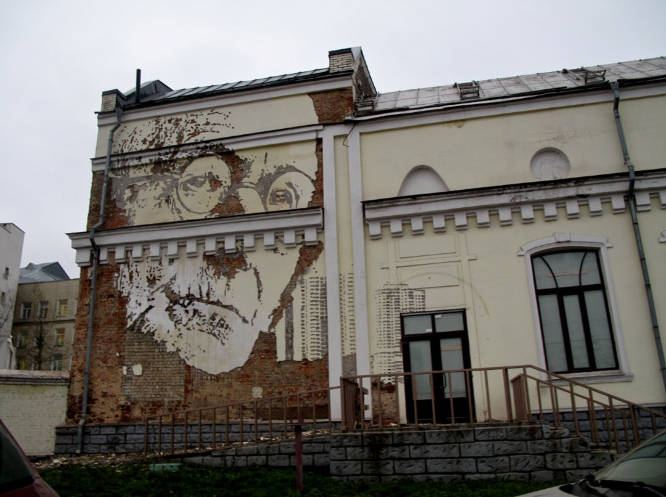
2) Which artists do you use for reference?

When I started I really admired artists related to Lisbon’s hardcore graffiti, some of them became friends, and I also admired artists from around the world that I got to see on magazines, movies, etc. Crews from Lisbon as GVS R1 3D 2S LEG 1003PV were big references, as the EWC from Poland, SDK from France and many others. After a while I discovered the work of Banksy, which inspired me to take a new direction, not in terms of style but in terms of concept and what to explore in urban art. Nowadays I admire the work of many people, including Gordon Matta-Clark, Katherina Grosse, JR, Conor Harrington, Word 2 Mother, NeckFace, Faile, Blu, Gaia, Barry McGee, Os Gêmeos and more.
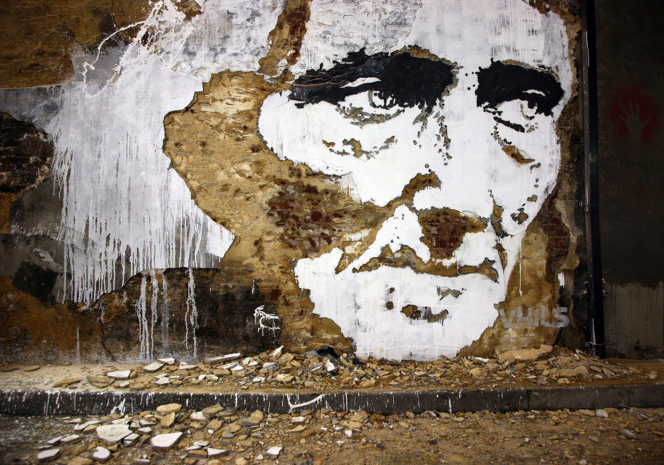
3) People recognize you for starting a destructive urban art movement, something new and fresh that nobody tried before. How did you develop this style and how would you describe it?

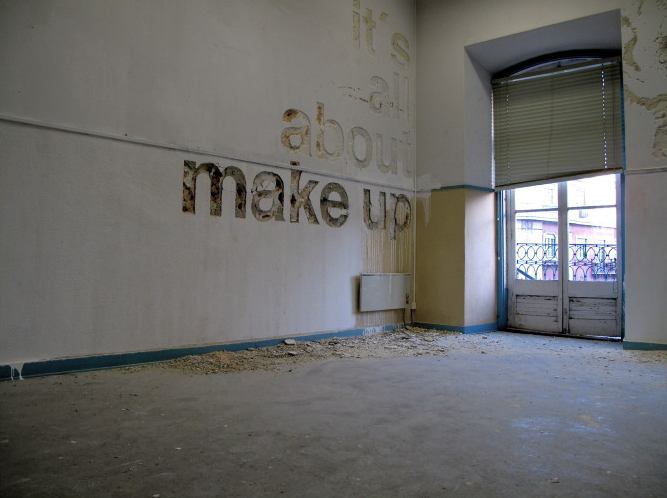
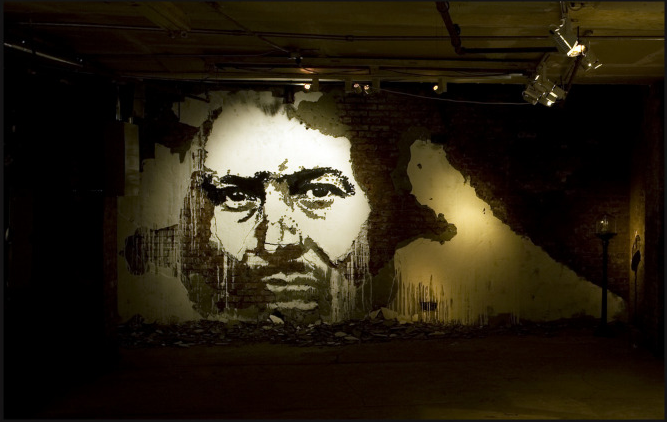
The development of this line of work has essentially two bases: one is graffiti in its most destructive side, which I have been connected to for many years; the second is the stencil technique that I discovered while I was looking for new paths that allowed me to express a new way of communication. From the first one I picked up the concept of destruction as creative strength – based on this idea I developed a way of work that uses the removal, decomposition or destruction. The concept is the idea that we are made by a series of influences that shape us throughout historical layers, etc, that come from the environment where we grew up. In a very symbolic way I believe that if we remove some of these layers, showing other ones, we can bring to surface some of the stuff we left behind, forgotten things that are still part of what we are today.

Technology is changing things so quickly that we don’t have enough time to think about what is changing (new layers), what is affecting us. I try to underline this process in general, my work can be seen as a kind of archeology that tries to understand what is hidden behind things. These ideas found expression when I started to experiment with the stencil technique and understood that I could revert the process to have more impact: instead of creating while adding layers, I explored the idea of creating by removing layers. I experimented with this process using several methods – cutting clusters of posters, corroding silkscreen ink with acid, etc. – and naturally things started to gain a brutal and raw shape.

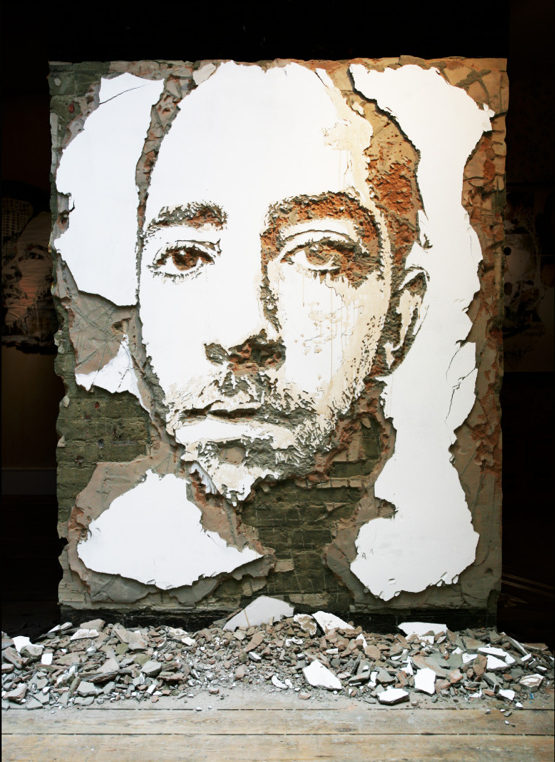
When I passed the idea to walls it was natural to work with this removal concept, this negative field. The process itself can be brutal and violent, but the result in my opinion, is expressive and poetic. The result was visibly interesting and allowed to start to incorporate the wall as one of the physical components to the intervention, unlike what happened to the painting, where the wall was a base. From there, the usage of explosives was another step that evolved after a lot of research and tests. These testing stages are something really nice to do, it’s actually a pleasure, and it usually results as a main part of my work.
4) Today there is a big discussion about the legitimacy of urban art and graffiti, what are the limits that an artist must put on his work and what exactly would be the public space. What is your opinion about this issues?

As a citizen I understand that this is a complex issue that can’t be seen as ‘light’ or black and white, yes or no – there are a lot of factors involved in this. In a more personal approach, in the other hand, I understand that we shouldn’t have limits in art, nor to the space where we apply it. No rules should be applied to art.

5) What do you think about the recent transition of several urban artists into fine arts and galleries? Is urban art still urban art inside a museum?

Yes, if the art is honest with its essence and if you take the space “to be what it is” and not be domesticated, which is a natural tendency in closed spaces because art in closed spaces is, essentially, marketable art. The museums may be exceptions to this because they disclose art, but not galleries, which usually are interested in selling art.

There is naturally a big difference between things produced freely on the streets and things produced to be showcased in a closed space, but I believe they are not opposites or exclude one another. For those interested in expressing their work both spaces are interesting, we just need to look at the productions inside their context. Street art is in a public space – what is produced for a gallery or museum is essentially a new version of a work, in a new context. What each artist makes with his work is something very particular.
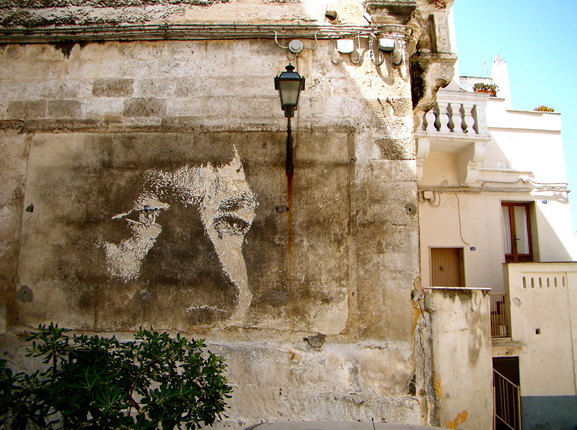
6) How do you describe your daily routine?

Actually it’s a bit complicated because I never know what will happen… It depends on where I am, and lately I’m always doing something in different places, so things vary a lot. In general I work everyday, in my house, studio or even at the airport – when I’m traveling. I don’t have a pre-defined space for work and pleasure, everything happens naturally. My life involves a lot of production, research and a lot of work, which I really like, so I don’t separate that. It’s pretty normal for me to be involved in several projects at the same time, and it’s usually in different countries. I have a base in Lisbon and another in London, it’s interesting to always be on the move but sometimes it’s hard to manage everything – sometimes I really need to stop everything and take some days off.
7) Which is your favorite piece so far?

I’m not sure, I usually like my latest work the most.

8) Tell us five lessons you believe are really important

1- There are no rules

2- There are no small materials

3- Persistence is key

4- In error we find creation

5-Go with the flow

9) Tell us sites that you like to visit
woostercollective.com

unurth.com

notcot.com

10) We would like to thank you again for your time and kindness, have a nice day Alexandre.

About the author

My name is Marcos Torres, I’m Graphic Artist from Porto Alegre, Brasil. You can get to know more about me by acessing my Personal Website or by following me on Twitter: @marcos333. You can also see some of my last projects at my Flickr.

Sponsored Links:


Abduzeedo Inspiration Guide for Designers at Amazon

Posted in Blog | Comments Off on Interview with Alexandre Farto (aka. Vhils)

What designers can learn from different animals

What designers can learn from different animalsDesigners of all types can gain inspiration from animals found in the wild. Many great designers exhibit behaviors similar to the movement, characteristics and instincts of nature’s creatures.

Accomplished designers understand that there is no greater and more perfect creation than what can be found in nature. Designers that adapt the behaviors, instincts or habits of animals into their approach will find that they will develop designs that are innovative and efficient.

This article will examine how animals can inspire designers of all types to greatness.

Each species is a masterpiece, a creation assembled with extreme care and genius. – Edward O. Wilson

1. Lion

Lions are considered the King of the Jungle because they prey on nearly every animal from leopards to cheetahs. They are brave animals that will challenge nearly every animal in the wild. Every day, they spend two to three hours walking and 50 minutes eating. The remaining 20 hours they are resting, socializing, or grooming. Most of a lion’s hunting is completed during the night hours until dawn.

Designers in the same way must be fearless. They must be brave enough to be innovative in their designs and land major contracts with companies. Designers must be highly adaptable to any environment, while maximizing their full potential. Great designs often come when we are alert and well rested. But often, designers must burn the midnight oil to present clients with their best options.

As lions and lionesses, designers must remain competitive and remain ahead of the competition to maintain their position as lead designers in their region or in the world. Lionesses are often more agile and do most of the hunting for their pride. Keep in mind that lioness designers may also dominate in some areas of design because of their natural instinct. Use this knowledge to your company’s advantage.


2. Tiger

Tigers have recently beaten out the dog for the world’s favorite animal. This animal is territorial and maintains a solitary lifestyle. They are camouflaged by their stripes and are simply unafraid to challenge any animal in the wild. Though the elephant is too large for the tiger to kill, the tiger will still try to intimidate the elephant nonetheless. Tigers have been known to successfully kill a rhinoceros, crocodile, moose, leopard, and numerous other large animals of the wild. They are faster than lions and can leap 10 meters or more, but they have very little stamina.

Tiger designers must not be afraid of the large projects that seem out of their scope. Just as the tiger challenges the elephant, designers must also meet challenges without fear. Designers must take their numerous solitary moments to create and develop a solid design. Though there are some moments of collaboration with the team and the client, designers must retreat to create their designs as quickly as possible to meet the client’s deadline. Like a tiger’s hunting style, designers must be strategic in accepting and planning projects to continually generate fresh new designs.

Shall we, because we walk on our hind feet, assume to ourselves only the privilege of imperishability? – George Eliot


3. Giraffe

Giraffes have several advantages over other animals in the wild kingdom. The most obvious is the giraffe’s height. They can reach and consume more nutrients than their competitors in the wild, such as the impala or kudu. The giraffe also has the shortest sleep requirements of any mammal in the wild. The average is approximately 4.5 to 4.6 hours per 24 hours.

Like giraffes, designers must be able to land more projects and reach higher peaks than our competitors. Designers must strive to view challenges from a different perspective and tackle the projects in a new light. Designers often have to adopt the behavior of giraffes and survive on 4.5 hours of sleep per night for short periods of time to complete major projects.


4. Camel

Camels are resilient creatures that can withstand incredible temperatures and water consumption levels that would kill other animals. They can retain a significant amount of water in their cells, kidneys, and intestines. They then can go long periods without water, because the fat tissue in the humps of the camel metabolizes and produces energy for the animal.

Designers need to be resilient and adapt to changes in the work environment that may seem unreasonable in other environments. The work hours are often long, but the end product of the designs are rewarding. Designers must be energetic and constantly evolving to provide a design that is better than the competition in the least amount of time possible.

Any glimpse into the life of an animal quickens our own and makes it so much the larger and better in every way. — John Muir


5. Cheetah

The cheetah, by far, has the fastest speed of any animal on land. The cheetah reaches speeds between 70 and 75 miles per hour. The cheetah can reach 62 mph in three seconds or less. After long sprints, they must rest for at least 30 minutes before achieving those speeds again. They may be the fastest in the wild kingdom, but their prey often escapes them because they will let them go, rather than risk an injury. Consequently, the cheetah’s success rate of landing their kill is only about 50%.

Designers must acquire some the cheetah’s instinct to survive. They must be agile and fast to land the project and complete it according to the deadline. Designers must not overwork themselves or they will “burn out” and produce lower quality work. Additionally, designers may run the risk of losing half of their clients. Speed, however, will delineate a designer from their competition.


6. Dolphin

Dolphins are highly intelligent animals. Their brains are highly complex, and they can hear frequencies ten times higher than the normal human being. Dolphins are social creatures and form strong bonds with people. They have been known to rescue injured humans or aid in human therapy. They also enjoy communication through a variety of clicks, whistles, and other sounds. Play time is an important part of their lifestyle and culture.

Design relies upon listening to the client and determining exactly what they need and desire. As designers, they must learn to listen better than their competitors. Designers must pick up on the nuances that their competitors will miss during the consultation. This will help your firm deliver a solution that meets the needs of the client.

Loyalty is a large part of building brand image. Designers must form relationships with customers and also fellow designers to build business. If a client is the victim of a bad design, designers must rescue them and offer a better solution. Designers, like dolphins, must engage their customers and peers in play to discover innovative ideas and solutions to problems.


7. Whale

Whales are one of the largest animals to have ever existed. They spend 90% of their lives under water and only surface to breathe through their blow holes. Whales cannot afford to consciously sleep or they will drown. Therefore, a portion of their brain is always functioning to keep them afloat.

Like whales, our creative juices are always flowing. At night, when we sleep, our subconscious may be thinking about the latest design. In the middle of the night, designers may wake up and sketch out an idea to avoid forgetting.

Some designers never achieve a deep sleep, because their most innovative ideas come when they lay down to rest. A designer’s job is often spent at the computer, drafting board, or with the client. When we come up for air, a designer truly needs to release just as the whale releases accumulated water through its blow hole.

Living with animals can be a wonderful experience, especially if we choose to learn the valuable lessons animals teach through their natural enthusiasm, grace, resourcefulness, affection and forgiveness. — Richard H. Pitcairn


8. Turtle

Turtles are excellent at hiding from their predators. They retreat into their shells and can hide completely submerged in water or on land. Some turtles are more agile than others depending upon their preference to water or land. Though turtles have incredible night vision, they move slowly because of their shells.

Often designers must hide or retreat to privacy to focus on a design for a client. Designers must learn to be methodical in their designs to ensure that they meet codes and also the client’s specifications. Being a visionary in design often allows you to see the entire picture when other designers fail to understand the client’s request. Turtles are protective of themselves and highly adaptable to different environments, as designers should be.


9. Owl

An owl’s hunting strategy is highly dependent upon the element of surprise. They blend in with their environment and are virtually invisible at times. Their feathers, also, allow them near silent flight. Their camouflage and silent flight comprise their competitive advantage in the wild.

Designers must know their competitive advantage in the world of design. Like the owl, designers must establish an edge that delineates them from the competition. Designers must be like chameleons and design for any type of environment. If you are an interior designer, you should be able to design modern contemporary, French country, or Renaissance spaces. Versatility and capturing your audience’s attention with the element of surprise is instrumental to success.


Conclusion

Whatever your style that you may have cultivated, you should demonstrate your ability and creativity by showing others your animal instincts through fearless and flawless design work.

Our task must be to free ourselves… by widening our circle of compassion to embrace all living creatures and the whole of nature and its beauty. – Albert Einstein


Written exclusively for Webdesigner Depot by Aidan Huang, a freelance developer, designer and ingenious blogger. He is one of the editors-in-chief at Onextrapixel. Follow him on Twitter @AidanOXP

What is your competitive advantage? Are you like the owl and can offer a unique design that will “wow” the customer, or are you more like the dolphin, skilled at listening and rescuing the client from impending danger?

Create Stunning Patterns with “Patterno” – only $9.97

Source


Posted in Blog | Comments Off on What designers can learn from different animals